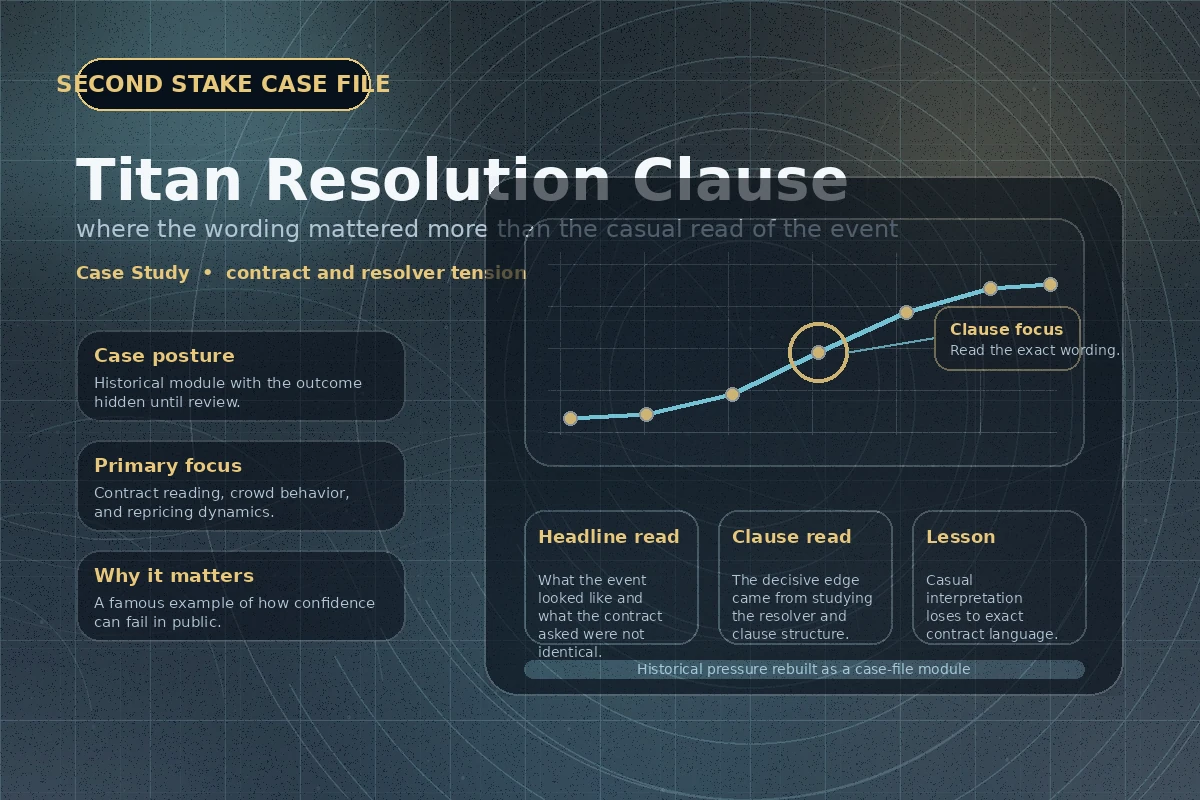
The headline version of a market and the actual contract can quietly be different markets. Commit a fake-money decision before you reveal the historical outcome.
Contract WordingIntermediate$1,000Gameplay 051
Open, layered, contract-first market reading.
Your seat at the table
You are reading a market where the public story feels obvious, but the resolution wording has specific conditions that may not match casual interpretation.
Market setup: A dramatic real-world event dominates attention. Traders talk about what happened, while the market resolves on exactly what the contract says counts.
Market context: This is the Contract Clinic module inside Second Stake. The lesson is that “everybody knows what this means” is not good enough when a resolver needs exact criteria.
Hidden enemy
Resolver Blind Spot
Resolver blind spot: the user reacts to the event while under-reading the mechanism that decides the market.
Bankroll: $1,000Skill: Reading exact wording before reacting to the story.Reveal locked until commit
What you know
The public story is emotionally clear.
The contract wording is specific.
The resolution source may care about wording more than vibes.
The market can resolve differently from casual expectation.
What you do not know yet
Whether the resolver will interpret ambiguous wording narrowly or broadly.
Whether late evidence will satisfy the exact criteria.
Whether the crowd is reading the headline or the contract.
Decision prompt
With $1,000 fake money, do you trade the emotional headline, trade the strict clause, wait for resolver clarity, or pass?
This is the commit point. Pick your posture, choose a fake-money stake, write the reason in your head, then press Commit. You cannot score yourself honestly if you read the reveal first.
Choose your posture
These labels are intentionally broad. The point is to name your decision style before history tells you which label feels smart.
Choose fake-money stake
How much of $1,000 are you willing to risk?
This is not real money. The stake exists so your decision has weight. Oversizing a comfortable story is part of the lesson.
Commit decision
Decision ticket
Choice:Not selected
Action:Choose a posture above.
Stake:Not selected
Select a posture and stake first. Then commit before opening the reveal.
Decision timeline
Move beat by beat. Ask what the market is inviting you to do and what the contract-aware version of you should do instead.
01
Headline clarity
React to headline or inspect wording.
Available information: The public story feels obvious and emotionally loaded.
Market pressure: Act before the price moves.
02
Clause inspection
Trade the clause, wait, or pass.
Available information: The exact criteria narrow the question.
Market pressure: The crowd may not be reading closely.
03
Resolver uncertainty
Demand clarity or pay for ambiguity.
Available information: Interpretation depends on source and wording.
Market pressure: Ambiguity can feel like edge.
04
Evidence conflict
Reprice your view or anchor to first read.
Available information: Public perception and resolution criteria may diverge.
Market pressure: The easy story becomes risky.
05
Reveal
Review whether you read or reacted.
Available information: Resolution follows wording.
Market pressure: The casual read was not the contract.
Reveal locked
Commit first. Then open history.
The reveal is hidden so the module stays honest. After you commit, the result, trap diagnosis, and review panels unlock below.
Historical reveal
The decisive issue is the exact resolution condition, not the emotional public version of the event.
Outcome: The case rewards readers who slow down and punishes users who assume the market means what a headline implies.
Your committed ticket:Review your selected posture and stake above.
Trap diagnosis
Resolver Blind Spot
This module turns Contract Clinic into a game. The user must identify what counts, what does not count, and who decides before choosing a side.
Lesson carried forward: Never trade a market until you can explain the YES case, the NO case, and the resolver’s likely interpretation in plain language.
After-action review
Score the process, not the outcome.
Could you state the exact YES condition before acting?
Did you separate public story from resolution source?
Did ambiguity make you feel clever instead of cautious?
Best process outcome: You isolate the resolution clause and refuse to treat public meaning as contract meaning.
Bad process outcome: You trade what the event feels like instead of what the contract resolves on.
Finish the loop
Carry the lesson into the Field Room.
Open the autopsy after you finish. Then run the related prompt and read the field note.