BYO-AI Prompt Workflow System
The better question comes before the better answer.
The Question Vault is now a workflow system for contract reading, resolver risk, counterarguments, crowd psychology, deadlines, Second Stake review, Elite Board review, and No-Play discipline.
24 Prompts8 CategoriesCopy-ReadyClinic-Linked

Open, layered, contract-first market reading.
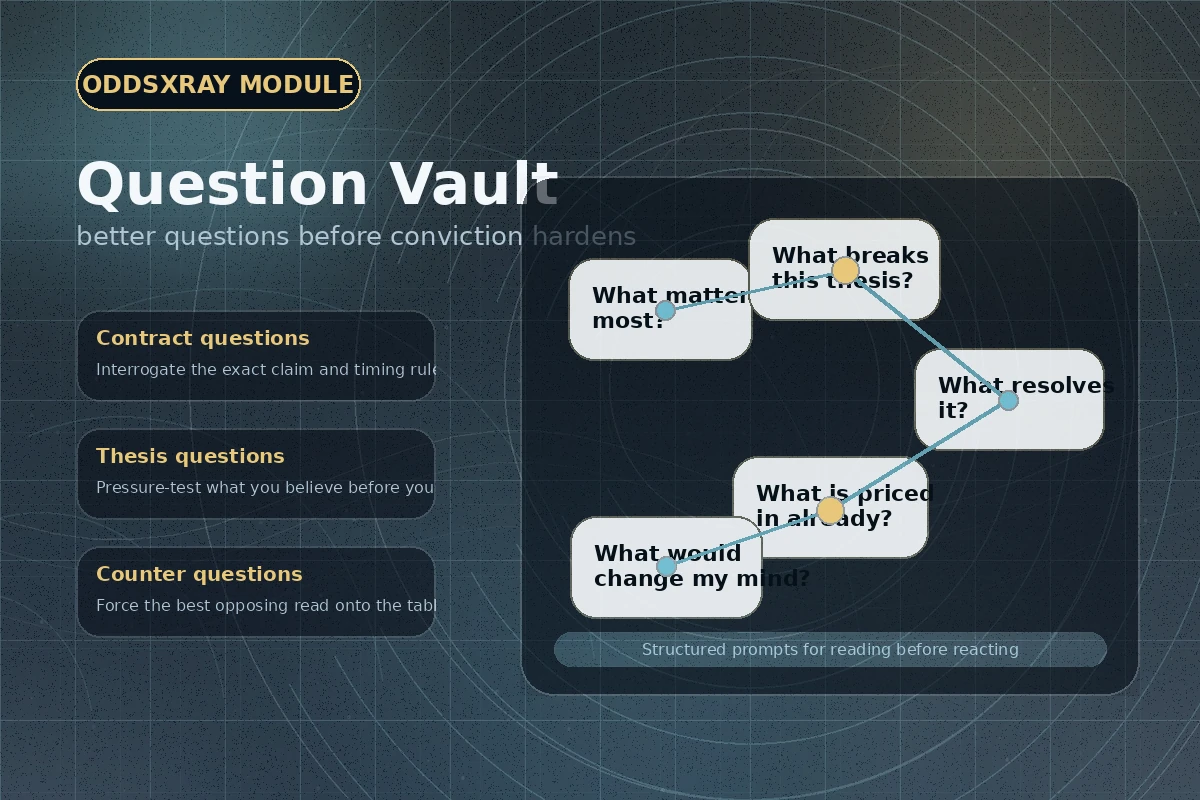
No AI access is included, and that is intentional.
OddsXray Field Room does not provide AI access. Members use their own AI account; OddsXray Field Room provides the market-specific questions, workflows, and reasoning structure.
The value is the discipline of the question: paste exact wording, demand edge cases, separate facts from claims, attack your own thesis, and review decisions after the outcome.
Clinic-linked
Use prompts that map directly into the Contract Clinic worksheet.
Review-linked
Use prompts after Second Stake or Elite Board review.
Discipline-linked
Use No-Play prompts when pressure is trying to force action.
Contract Reading
3 copy-ready workflows. Use them to structure thinking, not outsource judgment.
Contract Reading
Plain-English Contract Translator
When to use: Before touching any market where the headline and resolution wording may not match.
Defends against: Headline Trap / Resolver Blind Spot
Clinic step: 1–6: title, exact wording, resolver, date/rule, YES condition, what does not count
Contract Reading
YES / NO Condition Splitter
When to use: When the market wording is long, legalistic, or emotionally loaded.
Defends against: Clause Misread
Clinic step: 5–7: what must happen, what does not count, ambiguous edge cases
Contract Reading
Headline vs Contract Gap
When to use: When social media, news headlines, or market titles are louder than the actual rules.
Defends against: Headline Trap
Clinic step: 1–2 and 8: title, exact wording, likely crowd mistake
Resolver / Rules
3 copy-ready workflows. Use them to structure thinking, not outsource judgment.
Resolver / Rules
Resolver Risk Audit
When to use: When the market depends on a source, official report, committee, judge, platform decision, or exact rule.
Defends against: Resolver Blind Spot
Clinic step: 3–4: resolver / authority and resolution rule
Resolver / Rules
Official Source Map
When to use: When multiple sources are reporting different versions of the same event.
Defends against: Source Confusion
Clinic step: 3: resolver / authority
Resolver / Rules
Resolution Rule Edge-Case Audit
When to use: When the contract includes exceptions, platform discretion, timing nuance, or subjective interpretation.
Defends against: Edge-Case Blindness
Clinic step: 4, 6, 7: resolution rule, exclusions, edge cases
Counterargument
3 copy-ready workflows. Use them to structure thinking, not outsource judgment.
Counterargument
Strongest Opposing Case
When to use: After you think you found an edge and want to make sure you are not just excited.
Defends against: Favorite Bias / Thesis Attachment
Clinic step: 8–10: likely crowd mistake, research questions, decision note
Counterargument
Thesis Stress Test
When to use: Before deciding whether your thesis deserves real confidence.
Defends against: Hidden Assumption Trap
Clinic step: 9–10: research questions and decision note
Counterargument
What Does the Price Already Know?
When to use: When your thesis feels obvious and you need to know whether the market already priced it.
Defends against: Obvious Edge Trap
Clinic step: 8–10: crowd mistake, research questions, decision note
Crowd Psychology
3 copy-ready workflows. Use them to structure thinking, not outsource judgment.
Crowd Psychology
Crowd Failure Detector
When to use: During volatile moves, social pile-ons, consensus markets, and obvious favorites.
Defends against: Consensus Trap
Clinic step: 8: likely crowd mistake
Crowd Psychology
Consensus Fragility Check
When to use: When everyone seems to agree and the trade feels too clean.
Defends against: Consensus Trap
Clinic step: 8–9: likely crowd mistake and research questions
Crowd Psychology
Narrative Attachment Audit
When to use: When the story is emotionally satisfying, tribal, viral, or hard to let go of.
Defends against: Narrative Collapse
Clinic step: 8–10: crowd mistake, research questions, decision note
Timing / Deadline
3 copy-ready workflows. Use them to structure thinking, not outsource judgment.
Timing / Deadline
Timing and Deadline Check
When to use: When a market depends on a date, timezone, announcement, confirmation, or reporting sequence.
Defends against: Deadline Misread / Early Count Trap
Clinic step: 4: resolution date or rule
Timing / Deadline
Count-Order Risk Check
When to use: When early data may be structurally different from later data.
Defends against: Early Count Trap
Clinic step: 7–8: ambiguous edge cases and likely crowd mistake
Timing / Deadline
Event vs Announcement Check
When to use: When the market may care whether something happened, was reported, was confirmed, or was formally announced.
Defends against: Announcement Trap
Clinic step: 4–6: resolution rule, YES condition, exclusions
Second Stake Review
3 copy-ready workflows. Use them to structure thinking, not outsource judgment.
Second Stake Review
Second Stake Review Companion
When to use: Immediately after replaying a historical module.
Defends against: Process Drift
Clinic step: 10: decision note
Second Stake Review
Decision Post-Mortem
When to use: After a real or historical market resolves.
Defends against: Outcome Bias
Clinic step: 10: decision note
Second Stake Review
Stake Sizing Review
When to use: After choosing a fake-money stake in Second Stake or before sizing a real position.
Defends against: Conviction Without Calibration
Clinic step: 10: decision note
Elite Board Review
3 copy-ready workflows. Use them to structure thinking, not outsource judgment.
Elite Board Review
Elite Board Entry Audit
When to use: Before taking an Elite Daily Board entry seriously.
Defends against: Authority Shortcut
Clinic step: 9–10: research questions and decision note
Elite Board Review
Hidden Assumption Extractor
When to use: When a board entry or personal thesis feels obvious.
Defends against: Hidden Assumption Trap
Clinic step: 8–10: likely crowd mistake, research questions, decision note
Elite Board Review
What Would Change My Mind?
When to use: When you feel attached to a view and need a clean invalidation rule.
Defends against: Thesis Attachment
Clinic step: 9–10: research questions and decision note
No-Play Discipline
3 copy-ready workflows. Use them to structure thinking, not outsource judgment.
No-Play Discipline
No-Play Discipline Check
When to use: When you feel pressure to act because the board is moving or the story is exciting.
Defends against: Action Bias
Clinic step: 10: decision note
No-Play Discipline
Wait vs No-Play Splitter
When to use: When you know action is premature but are unsure whether the market deserves another look later.
Defends against: Forced Action Trap
Clinic step: 9–10: research questions and decision note
No-Play Discipline
FOMO Action Audit
When to use: When the chart, feed, or crowd makes you feel late.
Defends against: FOMO / Chase Trap
Clinic step: 8–10: likely crowd mistake, research questions, decision note
 What to do next
Pressure-test the answer with history.
After copying a prompt, play a Second Stake module so the lesson is felt under uncertainty, not just understood intellectually.
