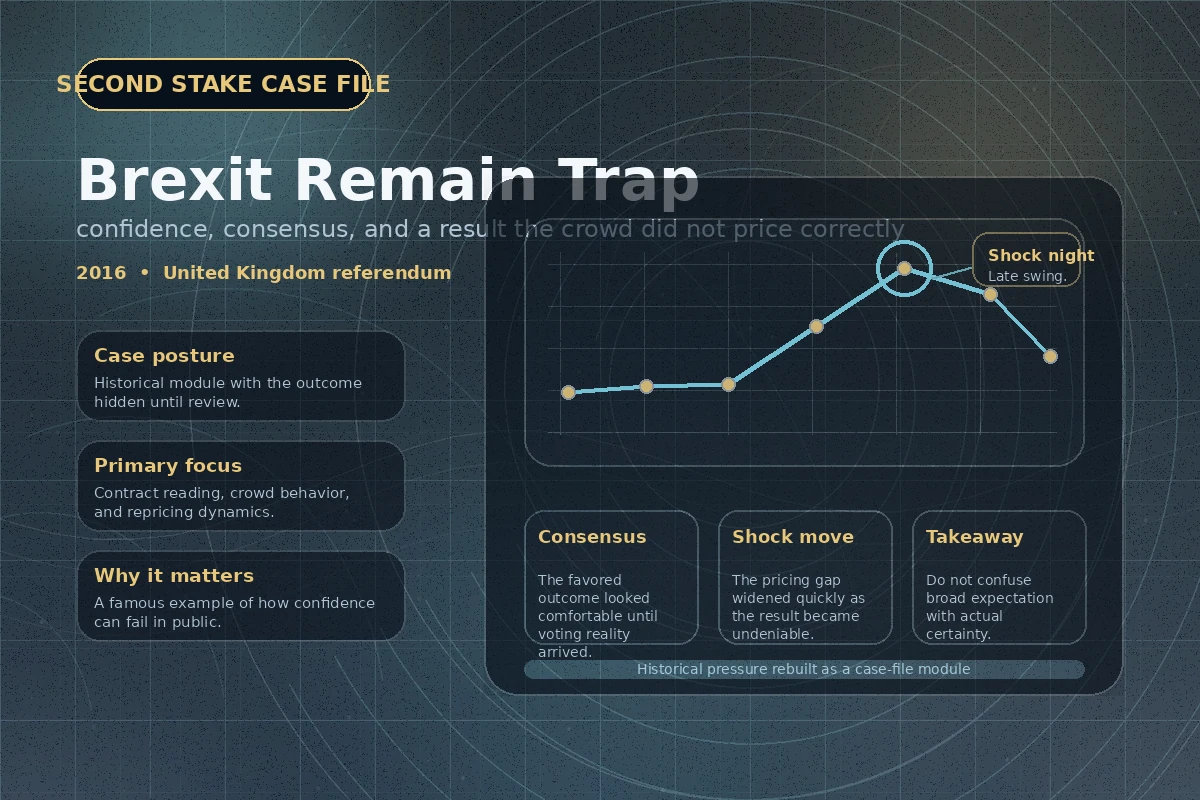
A market can look calm, confident, and institutionally favored while still being structurally vulnerable. Commit a fake-money decision before you reveal the historical outcome.
Crowd FailureBeginner$1,000Gameplay 051
Open, layered, contract-first market reading.
Your seat at the table
You are evaluating exposure before the referendum result becomes clear. The market is leaning Remain, the public mood is noisy, and the comfortable side feels socially safer.
Market setup: Remain is favored. Betting markets and many visible commentators treat Leave as possible but unlikely. Polls, regional signals, and turnout questions do not fully agree with the market’s calm price.
Market context: The referendum is close enough to matter, but the market tone makes Remain feel like the adult, reasonable, default outcome. The lesson is not that favorites are bad; it is that favorite pricing can sedate your risk sense.
Hidden enemy
Consensus Trap
Consensus comfort made the favorite feel safer than the actual uncertainty justified.
Bankroll: $1,000Skill: Detecting crowd overconfidence before the result is obvious.Reveal locked until commit
What you know
Remain is widely treated as the favorite.
Polling and political signals are mixed.
The price implies confidence, not certainty.
A binary referendum can reprice violently once real counts arrive.
What you do not know yet
Whether turnout patterns will match the comfortable narrative.
Whether regional Leave strength is being underpriced.
How quickly traders will abandon the favorite if the first clean signals contradict it.
Decision prompt
You have a $1,000 fake bankroll. Do you back the favorite, take the ugly contrarian side, reduce/hedge exposure, or pass until evidence improves?
This is the commit point. Pick your posture, choose a fake-money stake, write the reason in your head, then press Commit. You cannot score yourself honestly if you read the reveal first.
Choose your posture
These labels are intentionally broad. The point is to name your decision style before history tells you which label feels smart.
Choose fake-money stake
How much of $1,000 are you willing to risk?
This is not real money. The stake exists so your decision has weight. Oversizing a comfortable story is part of the lesson.
Commit decision
Decision ticket
Choice:Not selected
Action:Choose a posture above.
Stake:Not selected
Select a posture and stake first. Then commit before opening the reveal.
Decision timeline
Move beat by beat. Ask what the market is inviting you to do and what the contract-aware version of you should do instead.
01
Favorite comfort
Back the favorite, wait, or start a hedge plan.
Available information: Remain is favored and the price makes the favorite feel orderly.
Market pressure: The safe side feels obvious.
02
Polling noise
Add, reduce, hedge, or pass.
Available information: Public signals are not clean enough to justify emotional certainty.
Market pressure: Ignore the messy signals or admit the market is still fragile.
03
Late confidence
Trust consensus or protect against tail risk.
Available information: Consensus remains visible and socially reinforced.
Market pressure: The crowd makes inaction feel foolish.
04
First result stress
Exit, hold, chase, or obey the prewritten plan.
Available information: Early results begin challenging the comfortable side.
Market pressure: Panic repricing begins.
05
Reveal
Diagnose whether your choice was evidence-based or comfort-based.
Available information: Leave wins.
Market pressure: The favorite fails.
Reveal locked
Commit first. Then open history.
The reveal is hidden so the module stays honest. After you commit, the result, trap diagnosis, and review panels unlock below.
Historical reveal
Leave wins the referendum. The comfortable favorite breaks.
Outcome: The market’s calm did not equal certainty. Traders who treated consensus as a protective wall learned that consensus can vanish at resolution speed.
Your committed ticket:Review your selected posture and stake above.
Trap diagnosis
Consensus Trap
This module tests whether the user can distinguish probability from emotional comfort. The bad read is not believing Remain might win; the bad read is letting a favored price suppress the need for sizing, hedging, and counter-signal review.
Lesson carried forward: When the market feels calm, ask what would have to be true for that calm to be wrong. Then decide whether the price pays you enough for that possibility.
After-action review
Score the process, not the outcome.
Did you confuse high probability with certainty?
Did the market price make contradictory evidence feel less important?
Would you have sized differently if the consensus label were removed?
Best process outcome: You respect the favorite without treating it as guaranteed, reduce exposure, or deliberately pass rather than letting consensus size the trade for you.
Bad process outcome: You hold only because the market and public tone say Remain is safe.
Finish the loop
Carry the lesson into the Field Room.
Open the autopsy after you finish. Then run the related prompt and read the field note.