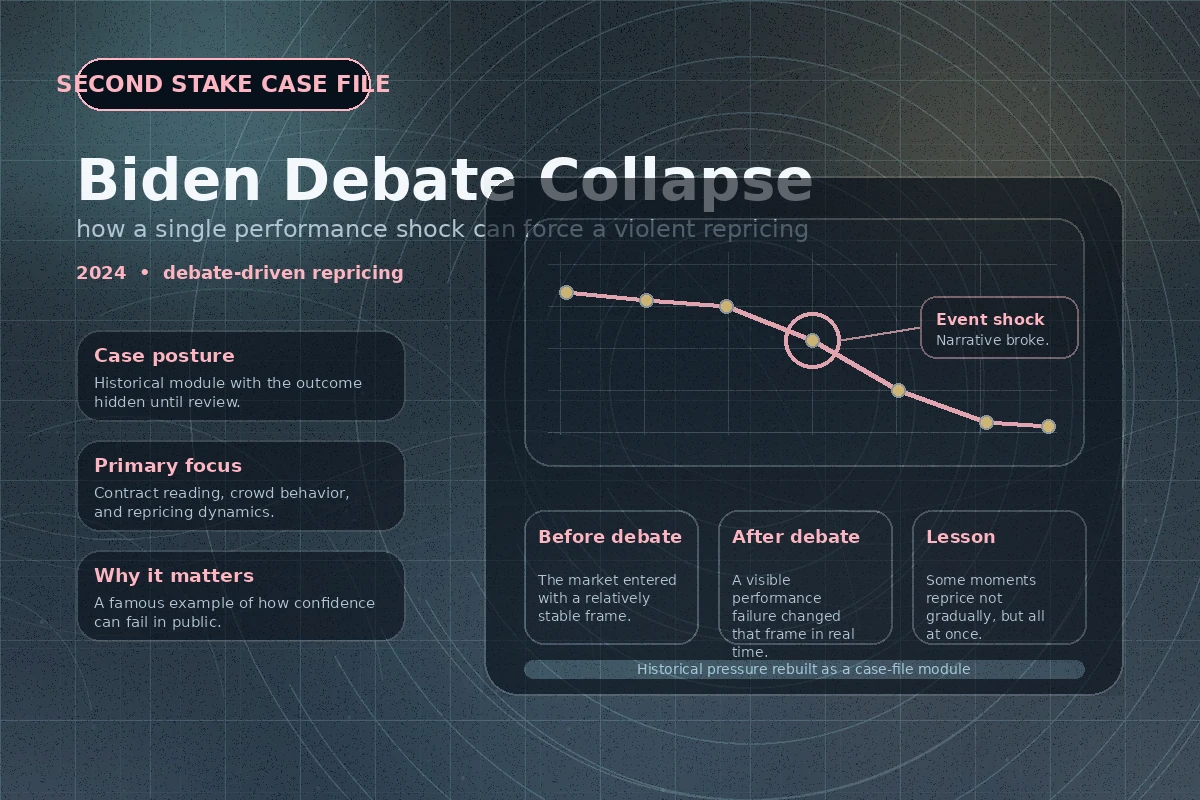
Some markets do not reprice gradually; they break when the narrative underneath them breaks. Commit a fake-money decision before you reveal the historical outcome.
Narrative CollapseIntermediate$1,000Gameplay 051
Open, layered, contract-first market reading.
Your seat at the table
You are watching a political market before and after a highly visible debate performance that may change perceptions of viability, replacement risk, and downstream outcomes.
Market setup: Before the event, the market has a relatively stable frame. After the event, the public narrative shifts quickly and forces traders to reconsider assumptions.
Market context: This module is about event shock. The challenge is deciding whether the market is overreacting, correctly repricing, or still underpricing a narrative break.
Hidden enemy
Narrative Collapse
Narrative anchoring made the user treat a frame break as noise.
Bankroll: $1,000Skill: Distinguishing temporary overreaction from durable frame break.Reveal locked until commit
What you know
A scheduled public event can change perception quickly.
The pre-event frame may be stale after visible evidence.
Narrative collapse can affect multiple linked markets.
Fast repricing can still continue if institutions react later.
What you do not know yet
Whether the event is a one-night overreaction or a durable narrative break.
How institutions, media, donors, and party actors will respond.
Whether the market has already repriced enough.
Decision prompt
With $1,000 fake money, do you fade the overreaction, follow the narrative break, wait for institutional confirmation, or pass?
This is the commit point. Pick your posture, choose a fake-money stake, write the reason in your head, then press Commit. You cannot score yourself honestly if you read the reveal first.
Choose your posture
These labels are intentionally broad. The point is to name your decision style before history tells you which label feels smart.
Choose fake-money stake
How much of $1,000 are you willing to risk?
This is not real money. The stake exists so your decision has weight. Oversizing a comfortable story is part of the lesson.
Commit decision
Decision ticket
Choice:Not selected
Action:Choose a posture above.
Stake:Not selected
Select a posture and stake first. Then commit before opening the reveal.
Decision timeline
Move beat by beat. Ask what the market is inviting you to do and what the contract-aware version of you should do instead.
01
Pre-event frame
Accept frame or prewrite what would break it.
Available information: The market enters with a stable view.
Available information: The performance challenges the old read.
Market pressure: Every trader wants a fast explanation.
03
Institutional reaction window
Hold thesis, update, or wait.
Available information: Media, donors, party actors, and linked markets may respond after the first move.
Market pressure: The first price may not be the final repricing.
04
Narrative consolidation
Recognize frame break or anchor to prior view.
Available information: The public conversation changes from event recap to viability question.
Market pressure: Old assumptions become harder to defend.
05
Reveal
Review whether you updated or resisted.
Available information: The event becomes a major market narrative break.
Market pressure: The old frame no longer explains the board.
Reveal locked
Commit first. Then open history.
The reveal is hidden so the module stays honest. After you commit, the result, trap diagnosis, and review panels unlock below.
Historical reveal
The debate becomes a major repricing event and shifts the conversation around viability and replacement risk.
Outcome: The market punishes traders who treat a narrative break as ordinary noise without inspecting the new incentives.
Your committed ticket:Review your selected posture and stake above.
Trap diagnosis
Narrative Collapse
This module asks whether the user can update without panic. The goal is neither blind chase nor stubborn fade; it is structured response to a visible break in assumptions.
Lesson carried forward: When a thesis breaks publicly, do not ask whether the move feels too large. Ask which assumptions survived the event.
After-action review
Score the process, not the outcome.
Did you predefine what would change your mind?
Did the size of the move make you dismiss the evidence?
Did you separate panic from genuine thesis break?
Best process outcome: You identify that the old frame has become stale and either wait for confirmation or size carefully around the new information.
Bad process outcome: You anchor to yesterday’s narrative because the move feels too dramatic.
Finish the loop
Carry the lesson into the Field Room.
Open the autopsy after you finish. Then run the related prompt and read the field note.