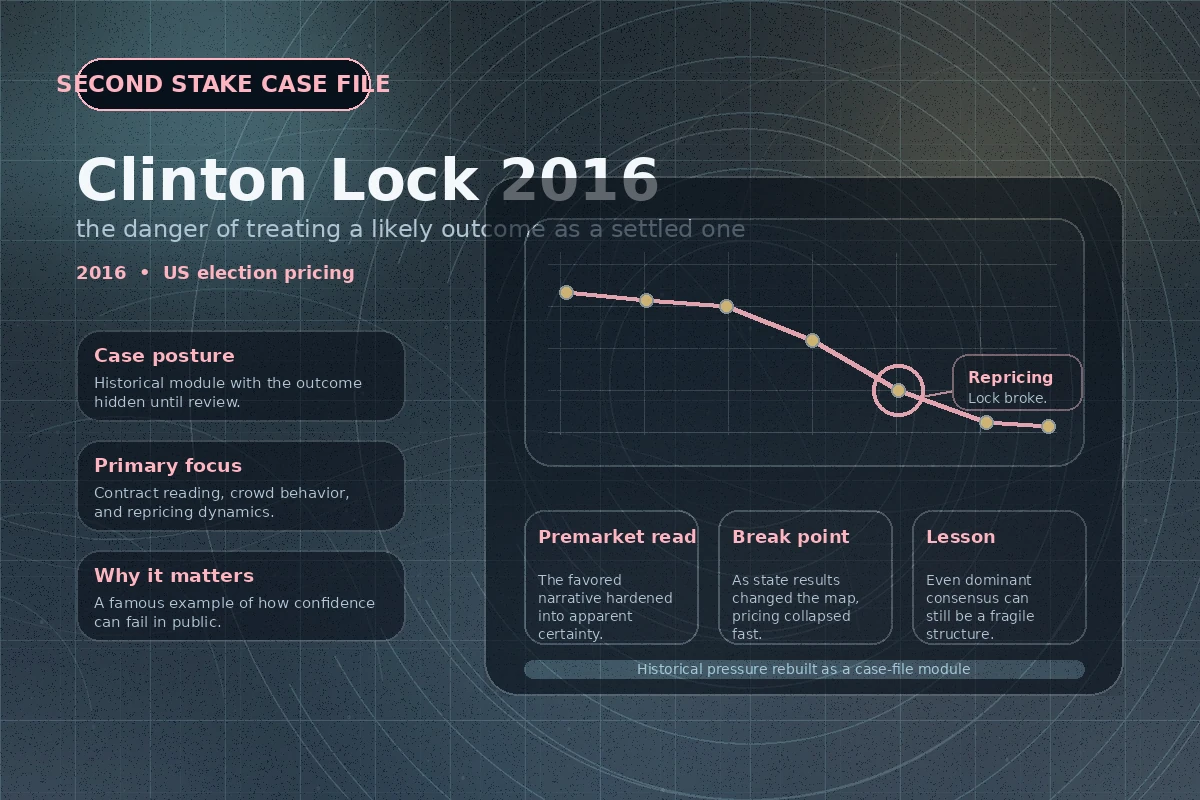
A likely outcome is not an inevitable outcome, even when nearly every visible authority sounds aligned. Commit a fake-money decision before you reveal the historical outcome.
Favorite FragilityBeginner$1,000Gameplay 051
Open, layered, contract-first market reading.
Your seat at the table
You are trading an election market where Clinton is treated as the favored, normal, institutionally supported outcome.
Market setup: Prediction markets and commentary broadly favor Clinton. Trump remains live but socially and analytically uncomfortable for many traders to price correctly.
Market context: The trade is not about whether Clinton should have been favored. It is about what happens when a favorite becomes psychologically upgraded from likely to locked.
Hidden enemy
Favorite Bias
Favorite bias made a likely outcome feel like a completed outcome.
Bankroll: $1,000Skill: Separating probability from inevitability.Reveal locked until commit
What you know
Clinton is favored in the market.
Public commentary reinforces the favored side.
State-level uncertainty still matters.
A favorite can lose if the electoral map breaks differently than expected.
What you do not know yet
Which state-level signals will dominate election night.
How quickly confidence will collapse if key states move against the favorite.
Whether the market has paid enough attention to fragility instead of national-level comfort.
Decision prompt
With $1,000 fake money, do you hold the favorite, buy the unpopular longshot, hedge, or pass because the price no longer pays for the fragility?
This is the commit point. Pick your posture, choose a fake-money stake, write the reason in your head, then press Commit. You cannot score yourself honestly if you read the reveal first.
Choose your posture
These labels are intentionally broad. The point is to name your decision style before history tells you which label feels smart.
Choose fake-money stake
How much of $1,000 are you willing to risk?
This is not real money. The stake exists so your decision has weight. Oversizing a comfortable story is part of the lesson.
Commit decision
Decision ticket
Choice:Not selected
Action:Choose a posture above.
Stake:Not selected
Select a posture and stake first. Then commit before opening the reveal.
Decision timeline
Move beat by beat. Ask what the market is inviting you to do and what the contract-aware version of you should do instead.
01
Consensus favorite
Hold, hedge, or start opposing-case review.
Available information: Clinton is priced and discussed as the likely winner.
Market pressure: The favorite feels institutionally protected.
02
Narrative hardens
Add to favorite or ask what could break it.
Available information: Commentary makes the longshot feel unserious.
Market pressure: Social proof pulls you toward the favorite.
03
State fragility
Reduce, hedge, buy longshot, or pass.
Available information: Narrow state outcomes matter more than national comfort.
Market pressure: Dismissing map risk feels easy.
04
Election night break
Panic or follow the earlier risk plan.
Available information: Key states begin moving against the favorite.
Market pressure: Late hedging is expensive and emotional.
05
Reveal
Review whether you paid too much for comfort.
Available information: Trump wins.
Market pressure: Consensus failed.
Reveal locked
Commit first. Then open history.
The reveal is hidden so the module stays honest. After you commit, the result, trap diagnosis, and review panels unlock below.
Historical reveal
Trump wins. The consensus favorite fails.
Outcome: The market exposed how fragile “everyone knows” can be when reality moves through a narrow resolution mechanism.
Your committed ticket:Review your selected posture and stake above.
Trap diagnosis
Favorite Bias
This module is a favorite-bias test. The user has to ask whether the price reflects evidence or social permission to stop thinking.
Lesson carried forward: When a market feels locked, make the unlock condition explicit before sizing. If you cannot say what breaks the favorite, you probably have not inspected the trade.
After-action review
Score the process, not the outcome.
Did public agreement shrink your sense of downside?
Did you inspect the map or only the narrative?
What would have changed your mind before the result?
Best process outcome: You treat the favorite as vulnerable, cap exposure, or hedge before the market breaks.
Bad process outcome: You overcommit because agreement feels like protection.
Finish the loop
Carry the lesson into the Field Room.
Open the autopsy after you finish. Then run the related prompt and read the field note.