When to use it
When early data may be structurally different from later data.
Warning: First information is not always representative information.
Related module: Red Mirage 2020
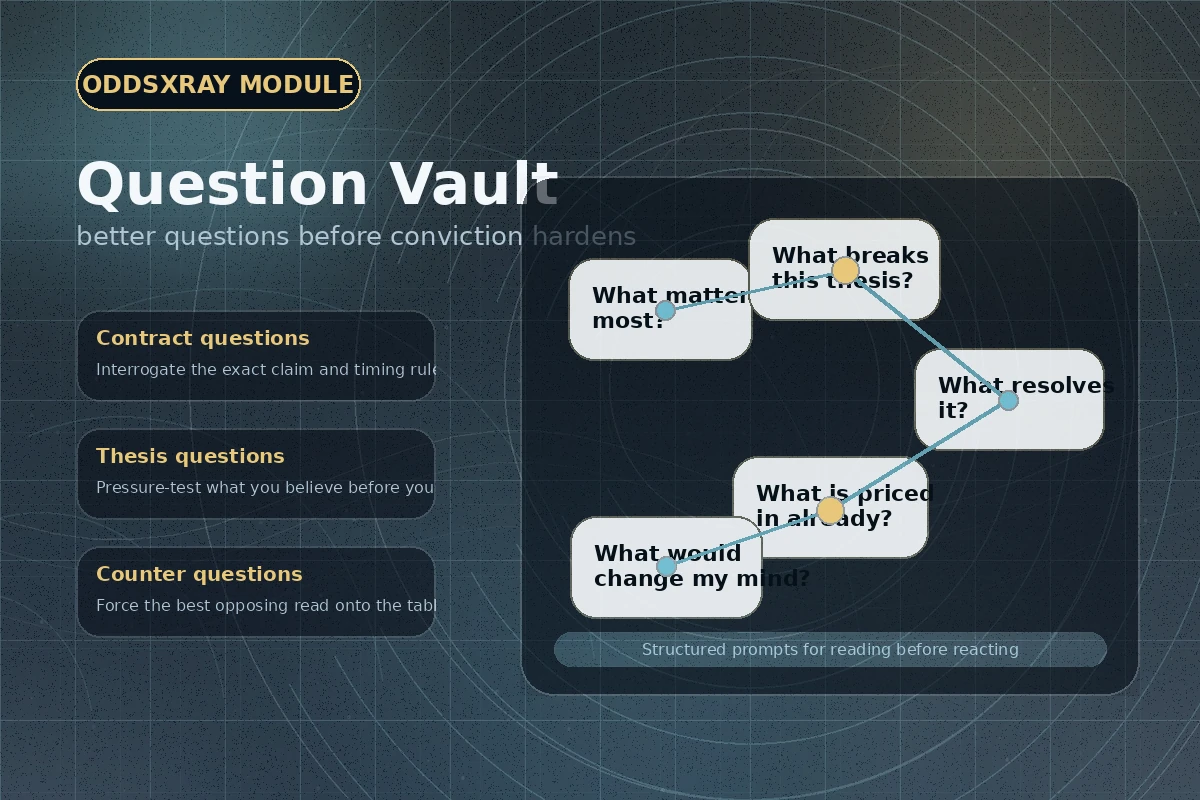
 OddsXrayQuestion Vault
Timing / Deadline
Use this prompt as a disciplined workflow inside the AI tool you already use. Paste actual market wording, sources, and your own thesis. Do not ask for prophecy; ask for structure.

Open, layered, contract-first market reading.
When early data may be structurally different from later data.
Warning: First information is not always representative information.
Related module: Red Mirage 2020
Do not paste vague summaries. Do not ask the AI what to bet. Do not accept an answer that ignores exact wording, timing, resolution source, counterarguments, or No-Play discipline. The output is a mirror, not a verdict.
Sequence-risk memo: early sample, later sample, bias direction, false impression.
Early Count Trap
7–8: ambiguous edge cases and likely crowd mistake
Red Mirage 2020
Paste into ChatGPT, Claude, Gemini, Grok, or your preferred AI tool. OddsXray gives the workflow; your AI tool does the writing and analysis.
Evaluate whether the current data is representative or just early.

Market:
[paste]

Current data/results/news:
[paste]

Answer:
1. What information arrived first?
2. Is early information structurally biased?
3. What information arrives later?
4. Which side benefits from early reporting?
5. Which side may benefit from delayed reporting?
6. What would a patient trader wait for?
7. What is the early-count trap here?
After the AI answers, force it into a final structure: exact contract read, main uncertainty, best counterargument, trap label, verification checklist, and whether Wait or No-Play is cleaner than forcing action.
Use this prompt alongside the worksheet so your market read stays attached to exact wording, resolver, timing, edge cases, crowd mistake, and a written decision note.
Open Contract Clinic